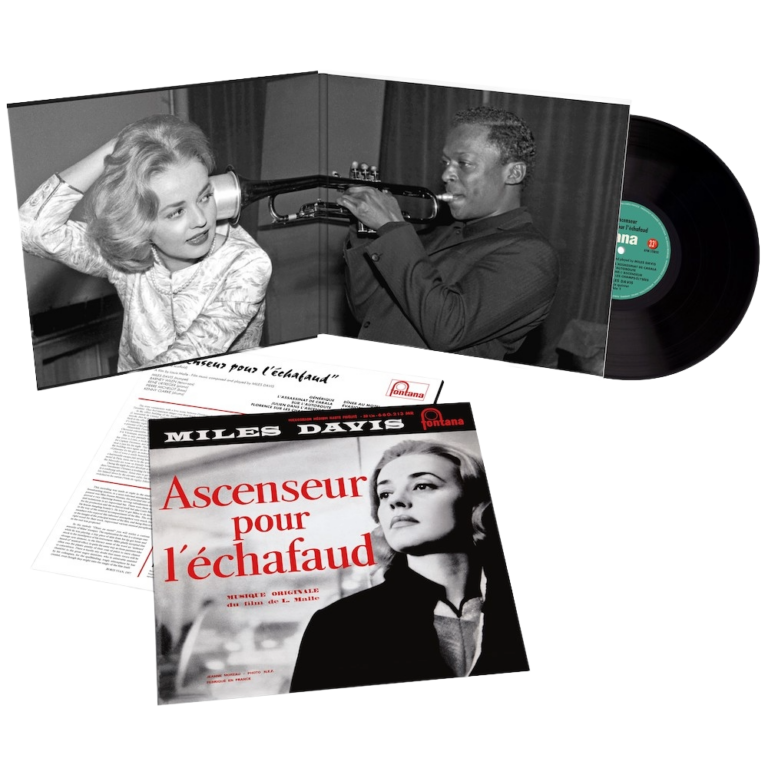
A glance through the filmography of Miles Davis, perhaps after immersing yourself in his music, reveals a consistent approach. There’s no chasing of applause, no rush to explain himself. What you see – and hear – is control, space, and a keen sense of what to leave out. Back in 1957, in Paris, Davis recorded the soundtrack for Louis Malle’s first feature, “Ascenseur pour l’echafaud” (Elevator to the Gallows) while watching the rushes. He improvised haunting lines, letting notes hang and fade, tracing Jeanne Moreau’s nocturnal footsteps with his trumpet – doing just enough, and no more.
It’s a stance – a way of being – that was evident from the get-go. Televised images of the iconic bandleader, broadcast on French TV on Christmas Day in 1957 (and rediscovered as recently as 2019), reveal a radically understated attitude to being filmed. There he is at 31, flanked by the same Paris quintet he assembled for the soundtrack, occupying a set designed to resemble a moonscape, performing a spare take on Jackie McLean’s ‘Dig’ – a tune he’d recorded six years earlier.
When others played, the besuited Davis stood almost completely still. Even the gradual lowering of his trumpet felt deliberate.
This composure became his default – evident on 1959’s The Sound of Miles Davis, a 24-minute broadcast recorded for CBS’s The Robert Herridge Theater. It featured a group including Miles Davis on trumpet and flugelhorn, John Coltrane on tenor and alto sax alongside Gil Evans and his orchestra. It is Davis, you feel, who draws the slow-moving camera toward him, rather than meeting it halfway.
By the electric era of the 1970s, Davis was flipping the script, turning his back to the audience for long stretches. At televised concerts and festivals – including Isle of Wight in 1970 – he often faces away from the camera or stood side-stage, letting the band build a dense electric groove before stepping in, adding a line and stepping out again. The focus was on the group. He was also evolving sartorially, eschewing tailored elegance for 1980s-glitz: bright jackets, wrap-around shades, clothes that flared in the light. At Montreux Jazz Festival 1986, on trumpet and keys, his gold lame trousers became part of the show.
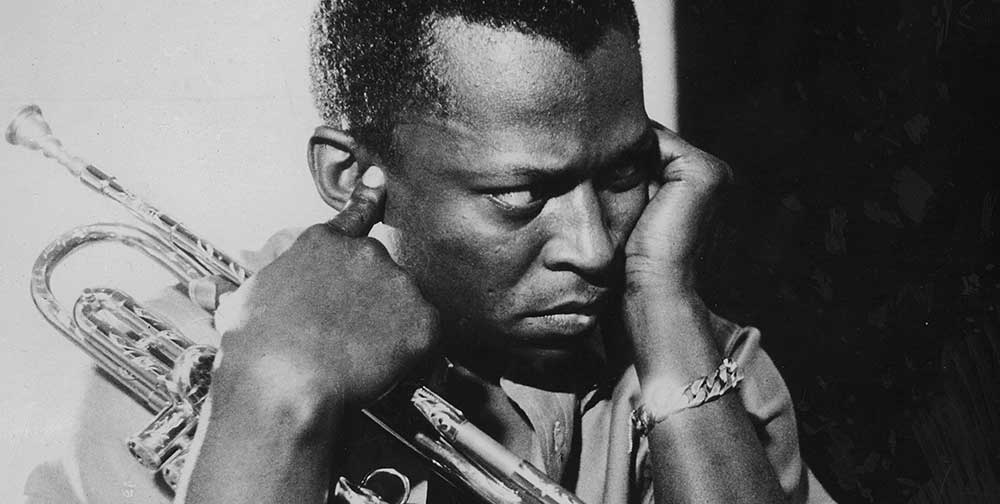
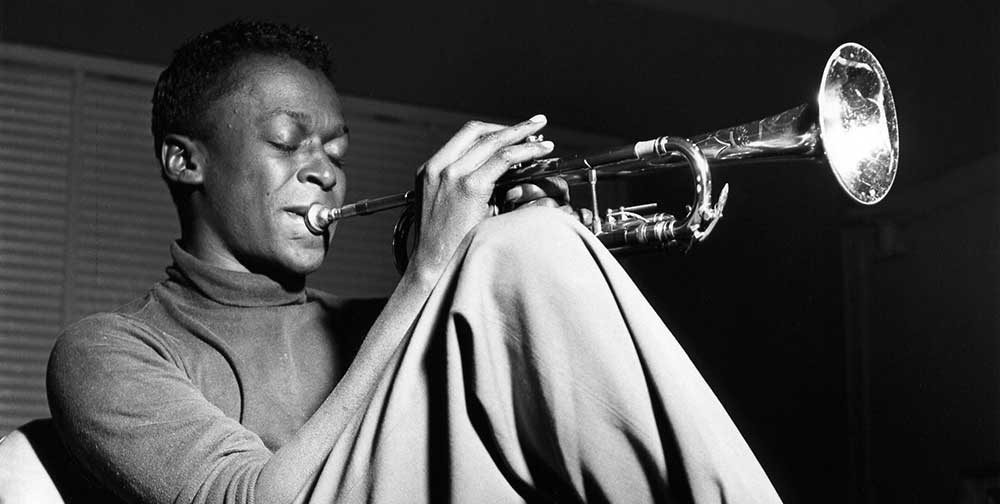
The style of Miles Davis captured on camera in the Getty Archive
Davis hadn’t appeared on network television in almost a decade when, in 1981, he surfaced – stronger than ever – on Saturday Night Live, performing ‘Jeanne Pierre’ with the likes of Marcus Miller and Mike Stern. Amid the skits and deliberate chaos, Davis’s aloofness felt like resistance.
When he was cast as smuggler-turned-pimp Ivory Jones in the TV cop show Miami Vice, in an episode aired during the show’s second season in 1985, he maintained that composure. ‘Whether it’s women or money, there’s knowing when to quit. I don’t know,‘ said Jones – Davis – with an almost unsettling calm.
In 1987, with guest saxophonist David Sanborn, he performed ‘We Three Kings’ on Late Night with David Letterman, flagging up the following year’s Christmas movie Scrooged, a Bill Murray vehicle in which Davis makes a cameo as a busker before a handwritten sign reading ‘Feed the starving musicians’. In June 1989 he appeared on the Arsenio Hall Show – performing ‘JoJo’ from “Amandla” then being interviewed while seated next to Sigourney Weaver. He spoke of his early practice technique of spitting out black-eyed peas and rejected being labelled as ‘legendary’. “I’m not finished yet,” he said.
There’s dry wit in his 1989 feature-length interview on 60 Minutes – one of America’s most watched television programmes. It’s there in the single raised eyebrow he offers in response to more inane-type questions from his mismatched interviewer (‘Do you even like white people?) yet it is presented, nevertheless, as part of a controlled image. His embrace of luxury and elegance, his assertion of style, his ownership of what was deemed ‘bad’ (he admitted to being a ‘pimp’ who used wealthy women for money), pushed back against stereotypes – reflexively as well as intentionally.
The character he plays in Dingo, a 1991 curio from Australian filmmaker Ralph de Heer, is a jazz icon with a personality so close to that of Davis that his authority requires no explanation. A performance scene in which the camera lingers on his face feels storied, documentary-like, because of who Davis is.
The persona came fully formed. By the time of his final live performances at Montreux that same year, everything is reduced. Close ups show breathing, timing, concentration. When he lowers his trumpet and stands still as the band continues, the camera stays with him. And Miles Davis – by then fully, unmistakably Miles Davis – holds your attention.
READ ON…
Miles Davis’ Best Albums: His Six-Decade Career in 8 Essential Albums
The Making of Miles Davis’ “Birth of the Cool”
Jane Cornwell is an Australian-born, London-based writer on arts, travel and music for publications and platforms in the UK and Australia, including Songlines and Jazzwise. She’s the former jazz critic of the London Evening Standard.
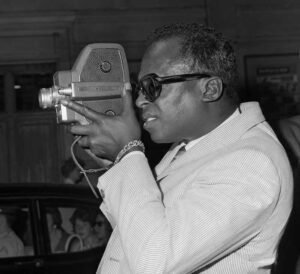
Header image: Miles Davis films his arrival to the station Saint Lazare in Paris. Photo:Robert Siegler\INA via Getty Images.