

John Coltrane’s “Giant Steps”, first recorded in 1959, is one of the most famous compositions in jazz, and one where Coltrane’s use of harmony has made a big impact on jazz musicians ever since.
The composition of Giant Steps has a very structured approach to harmony, almost to the extent of being a musical study. A particularly striking aspect of the harmony is its focus on the interval of a Major 3rd between chords. Let’s look at the composition in more detail.
Here is the lead sheet for “Giant Steps”, showing the melody line and chord symbols:
[fig. 1 – Giant Steps Lead Sheet]
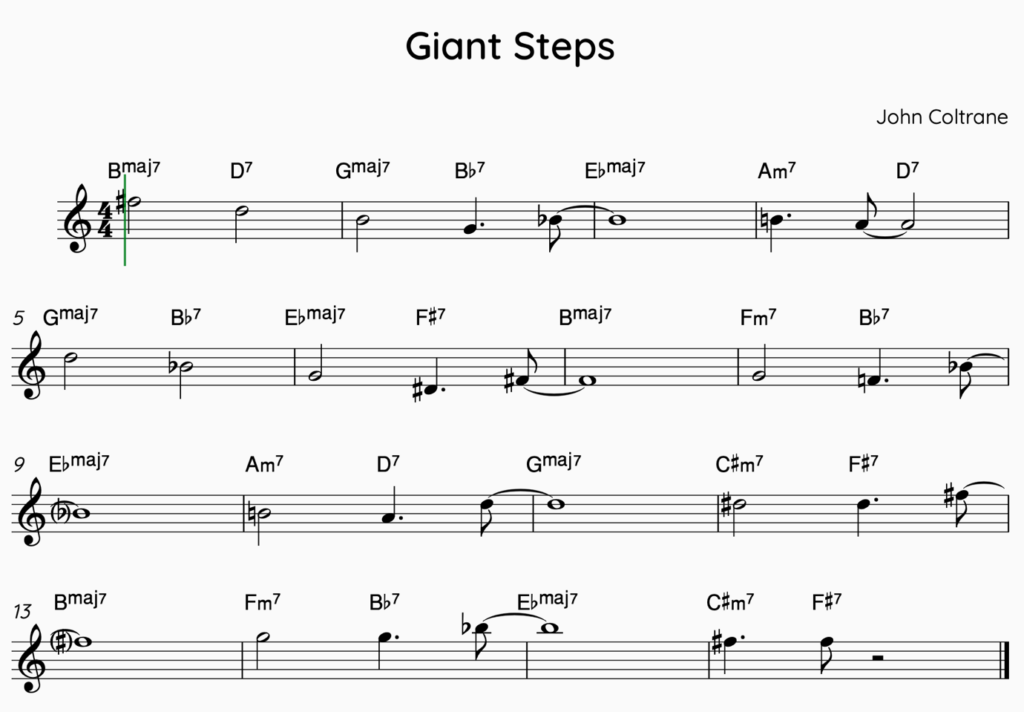
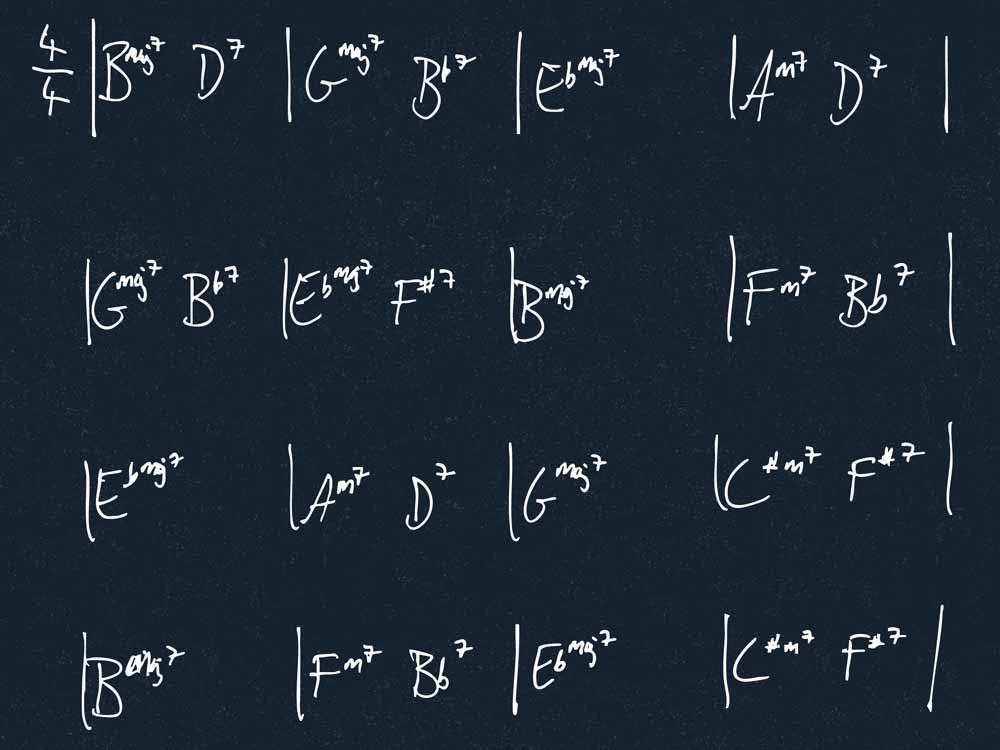
As we can see, the composition is based on a 16-bar structure and there are a lot of patterns at play in the harmony. Let’s take out the melody and look just at the chords.
[fig. 2 – Giant Steps chords]
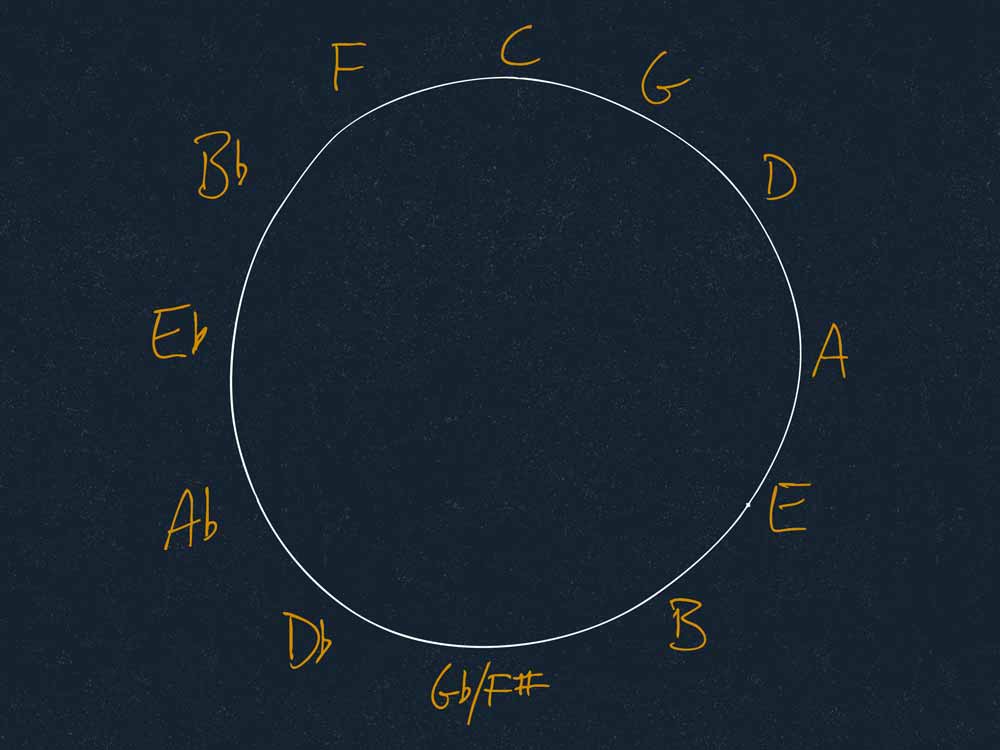
A traditional concept used in harmony, whether in classical music, jazz, pop or elsewhere, is the Circle of Fifths. This is where the twelve individual pitches of the chromatic scale are organised in a circle of perfect fifths. So, if the first pitch is C then the next one going clockwise around the circle will be G (a perfect fifth up from C), then D (a perfect fifth up from G) and so on, as shown here:
[fig. 3 – The Circle of Fifths]
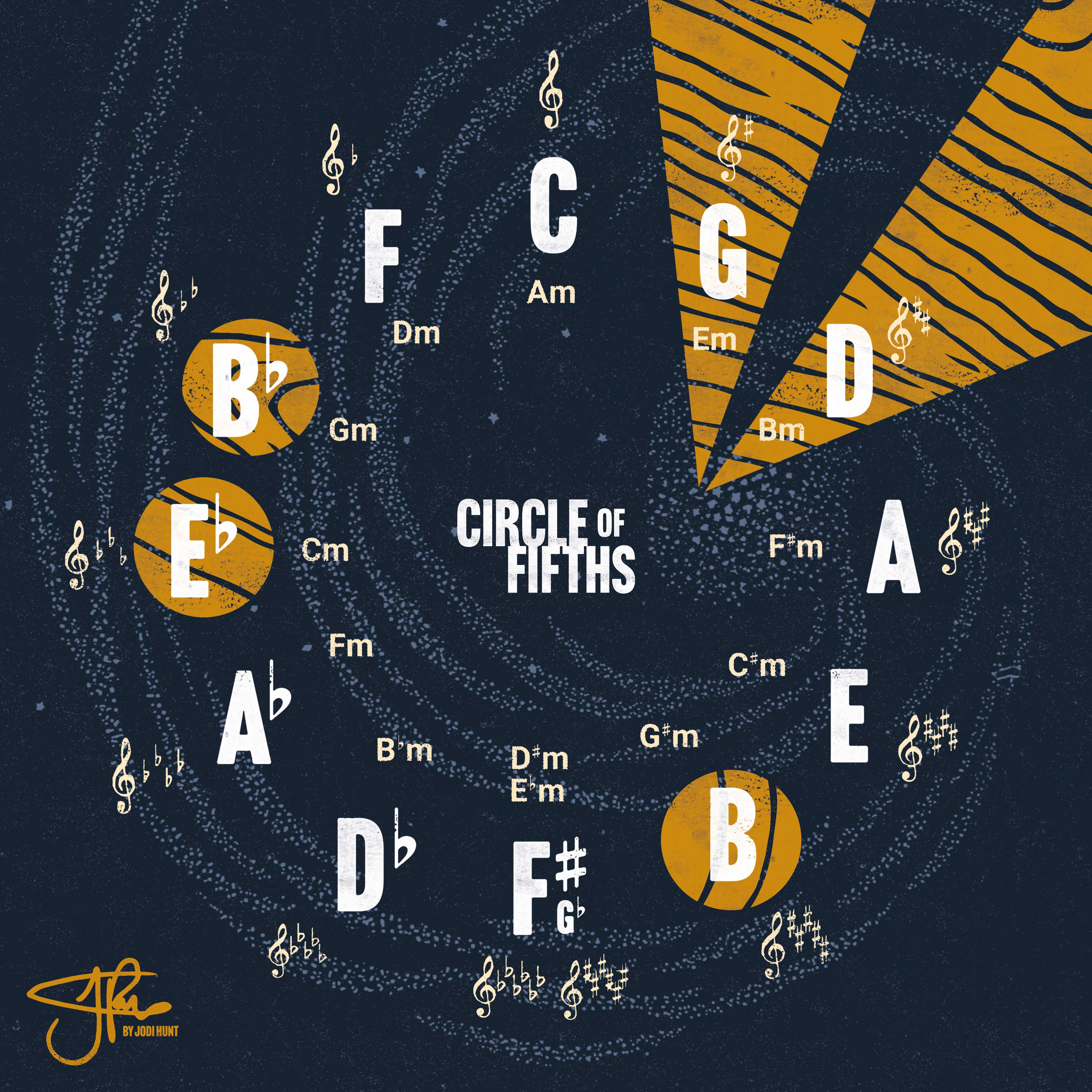
This arrangement of pitches organised in fifths has various applications in music. For example, it can be used to illustrate the different major and minor key signatures. Starting with C major (or it’s relative minor, A minor) at the top of the circle, for every step you take around the circle clockwise you add one sharp to the key signature, while for every step you take anti-clockwise you add one flat, with both culminating at the bottom of the circle with the maximum number of sharps or flats, as shown here:
[fig. 4 – Circle of Fifths Illustrating Major and Minor Key Signatures]

Movement in fifths is also very important in “cadences” in music, which are used to define a key center. What is known as a “Two-Five-One” progression in jazz (often notated in Roman Numerals as II-V-I) is a chord sequence with a strong cadential quality. In traditional harmony, a “Perfect Cadence” is a Five-One (V-I) progression of chords (also known as “Dominant” and “Tonic” respectively), which has a sense of resolution bringing us back to the home key. So, if the key of the music was C major then these two chords – in their simplest form as triads – would be G major and C major.
[fig. 5 – A Perfect Cadence in C]

The sense of resolution in this progression can be made even stronger if the dominant (or V) chord is made into a seventh chord, rather than a standard major triad, so in this case the chords would be G7 and C major, as shown here:
[fig. 6 – dominant seventh example]
As can be seen on the Circle of Fifths diagram (fig. 3), the dominant, or V (five), chord is one step around the circle from the “tonic” or I (one). We can make the sense of musical resolution in this sort of cadence even stronger by preceding it with a chord one further step around the circle. In classical music, this chord would be called a “Secondary Dominant”, while in jazz it is the II (Two) of our II-V-I (Two-Five-One) progression. So, staying in C major as our example, and going two steps around the Circle of Fifths, this would give us a chord rooted on D (which is the second degree of the scale, hence “II”. Unlike the other two chords, this would be a minor chord, as in our example key of C major there is no F# to give us a D major chord, but instead an F natural, giving us D minor. So, a full II-V-I (two-five-one) progression in C major would look like this:
[fig. 7 – a II-V-I progression in C Major]

In “Giant Steps” there are several examples of these II-V-I progressions, as shown here:
[fig. 8 – II-V-I Progressions in “Giant Steps”]
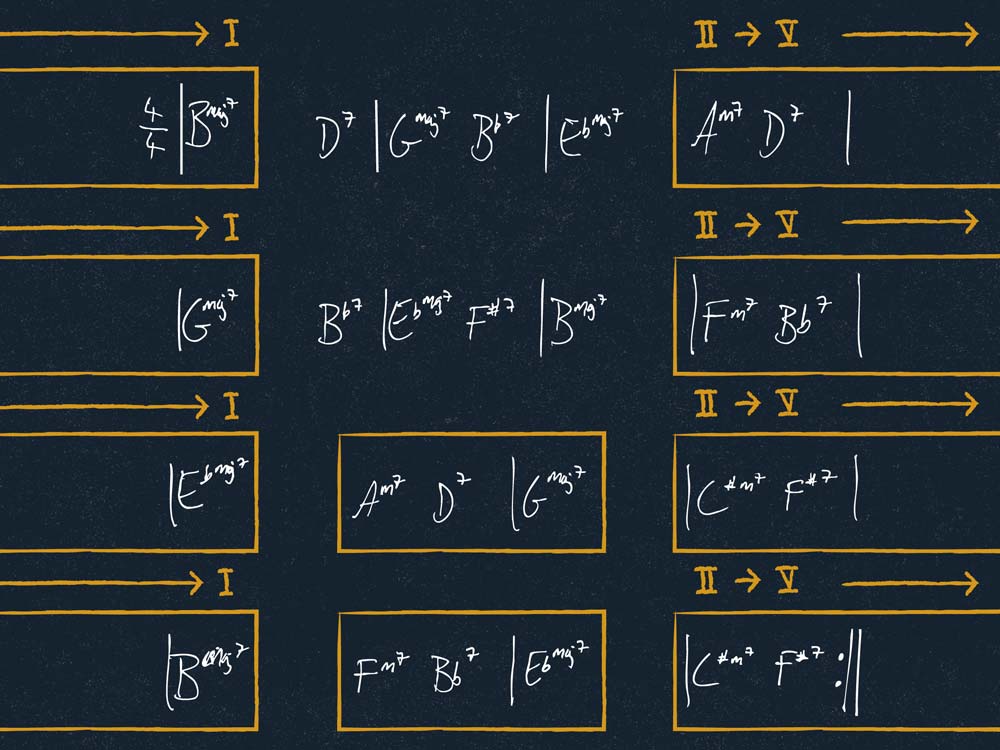
But as well as these traditional patterns based on movement in fifths in “Giant Steps”, what is more distinctive about the composition is its particular focus on movement in major thirds.
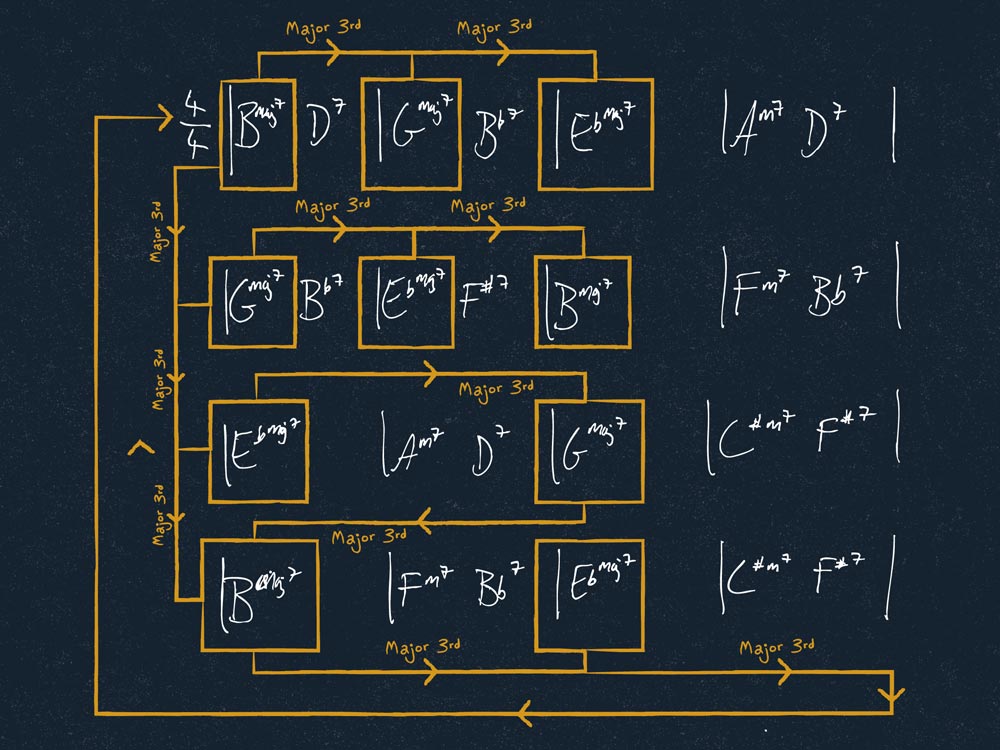
Giant Steps is not in a single “key” in the traditional sense. Instead, it is based on movement through different “key centers”, where each individual key is temporary in the music before moving rapidly on to the next (which, coupled with its rapid pace, is the reason that it is regarded as a difficult piece to play). As can be seen, these individual key centers move in major thirds:
[fig. 9 – Major Third progressions in “Giant Steps”]
Even this movement in major thirds could in fact be rooted in the Circle of Fifths. In his definitive biography of John Coltrane, Coltrane expert Lewis Porter writes,
“During the late 1950s he would draw the circle of fifths and then connect the twelve key centers with lines… Sometimes he’d place an equilateral triangle within the circle, creating a “magic triangle,” and Marcello Piras has shown that if one does that, the points of the triangle connect key centers a major third apart”
If we draw such an equilateral triangle on the Circle of Fifths, with its apex at the top at C, it would look like this:
[fig. 10 – Equilateral Triangle in the Circle of Fifths on C]
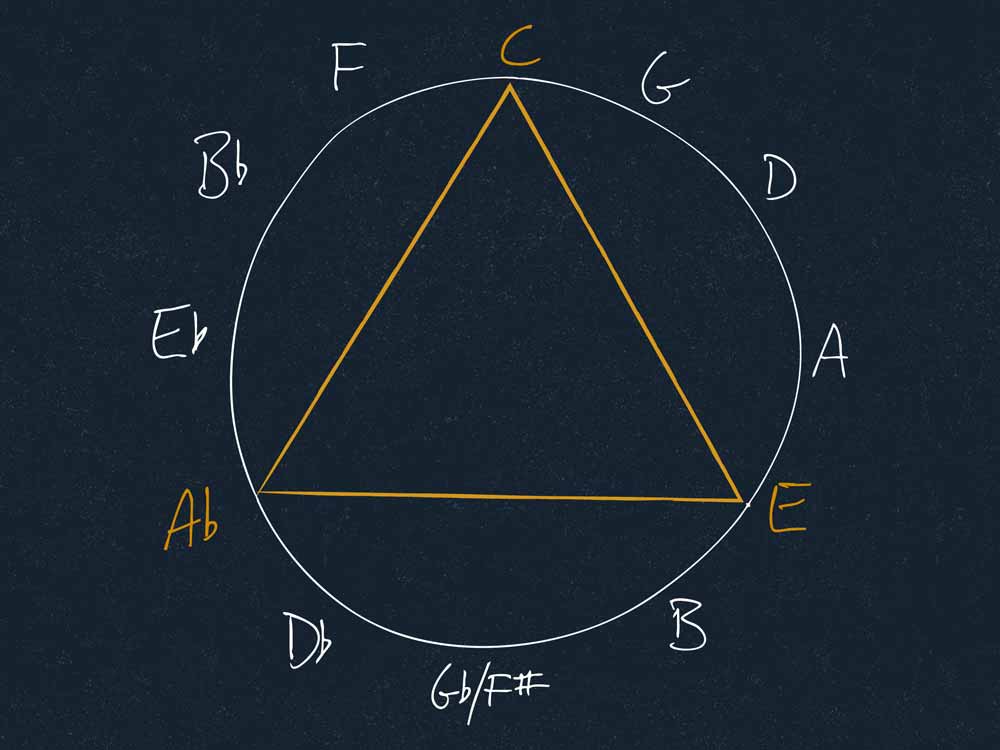
As can be seen, it connects key centers a major third apart – C, E and Ab.
If we rotate this triangle by one degree around the circle, it would look like this:
[fig. 11 – Equilateral Triangle on the Circle of Fifths, Rotated One Degree]
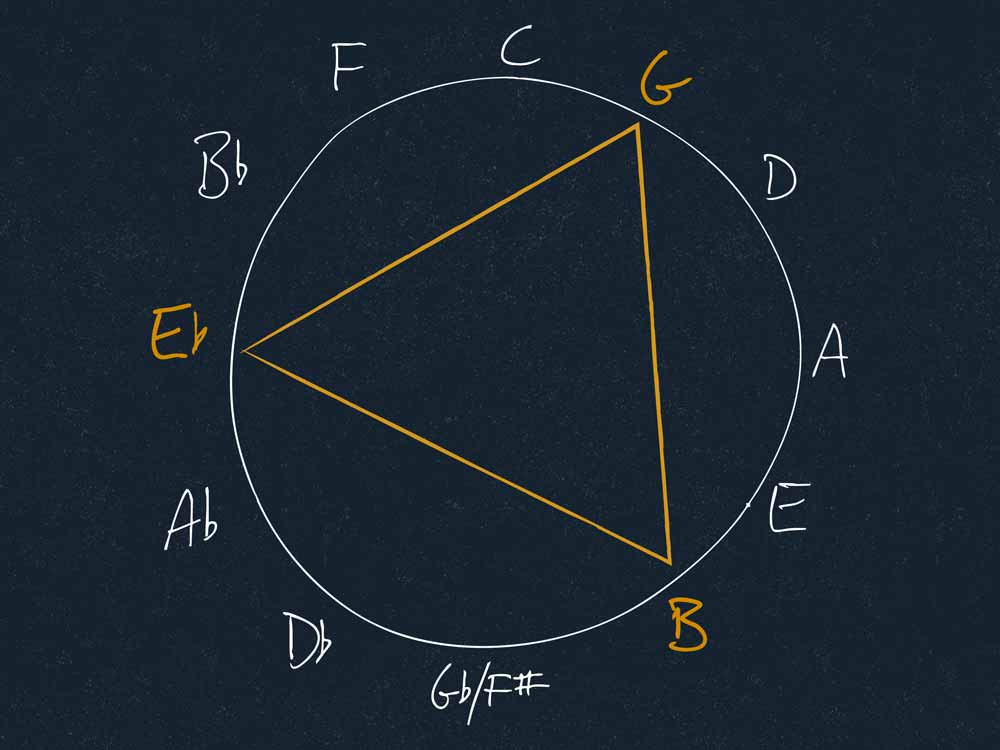
As can be seen, the key centers now connected are G, B and Eb. If we look back at our diagram of Major 3rd progressions in Giant Steps (fig. 9), we can see that these are the exact chords that appear repeatedly (as Major Seventh chords) in Giant Steps.
It can be seen that the chord structure of Giant Steps is extremely methodical based on these two principals – 1) movement in Major 3rds creating different key centers, and 2) cadential progressions that reinforce these key centers.
Let’s look in stages at how to piece this together.
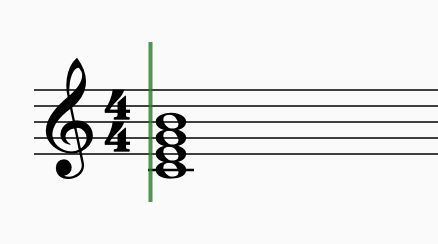
Each individual key centre is represented in the chord sequence by a “major seventh” chord. A major seventh chord is a simple major triad (so on C this would be C-E-G), with a major seventh added (so on C this would be a B, making C-E-G-B).
[fig. 12 – C major Seventh Chord]
Let’s start with Giant Steps by putting in all the major seventh chords and leaving the others blank for now:
[fig. 13 – Giant Steps major seventh chords]
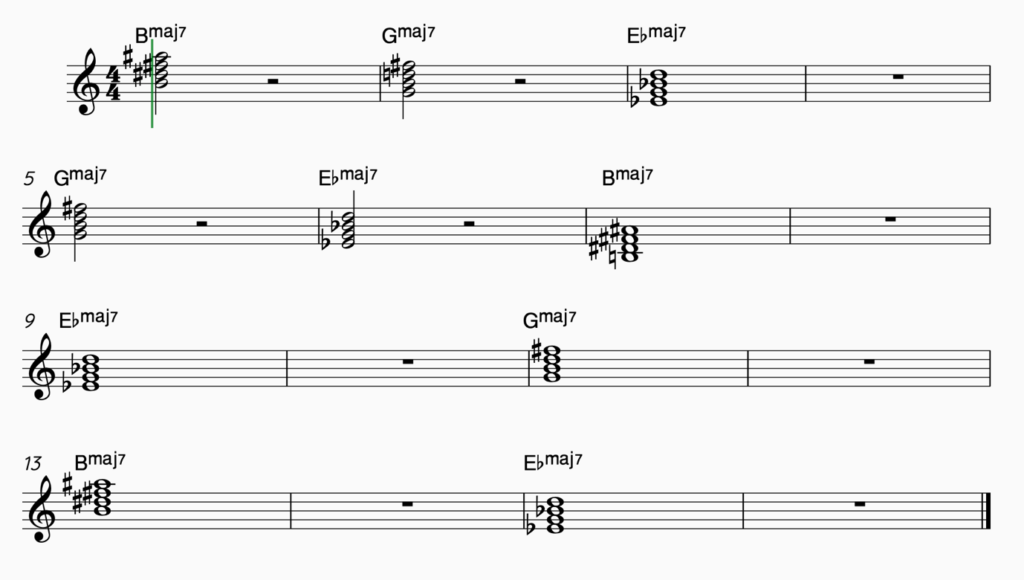
Looking at the first line of four bars, we begin on B major seventh and then rotate anti-clockwise around the points of our equilateral triangle from fig. 11, so first moving down a major third to G major seventh, then a further major third to Eb major seventh.
On the second line of four bars we repeat the exact same pattern, but this time transposed a major third down from where we started, so beginning on G major seventh, then down a major third to Eb major seventh and then another major third to B major seventh.
On the third line we begin as though continuing this same overall pattern, with the line starting another major third down from the start of the previous line, so this time on Eb major seventh. But this time, rather than descending at a rate of one key center per bar, we instead ascend – still by major thirds but upwards and at the slower rate of one major third per two bars. So, Eb major seventh is followed by G major seventh, followed by B major seventh, followed by Eb major seventh, reaching the end of the form.
So, it can be seen from this that there is an extremely pattern-based structure to the key centres on major seventh chords in Giant Steps. This covers all of the major thirds movement in the piece. The remaining step, to complete the remaining chords of the composition, is to then fill in all the gaps between these chords with cadential movement in fifths that reinforces each key centre. This is done entirely with either V-I (five-one) or II-V-I (two-five-one) progressions, with seventh chords for the V (five) chords and major seventh chords for the I (one) chords.
[fig. 14 – Giant Steps cadential progressions]
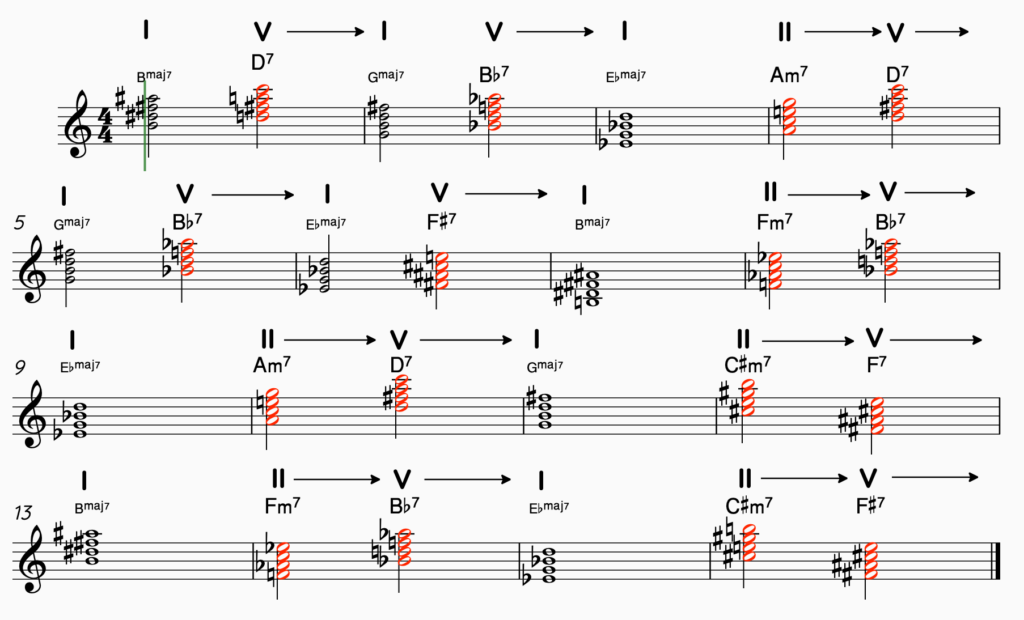
As can be seen, the whole harmonic structure of Giant Steps is devised from these two concepts. There are three types of chords – major sevenths, sevenths and minor sevenths. Each of the major sevenths acts as a new key center. Each of the sevenths acts as a dominant (V) chord leading to the next key center, and each of the minor seventh chords acts as a “II” chord, leading to a dominant (V) chord, leading to the next key center.
John Coltrane’s interest in patterns in music is clear. Giant Steps is perhaps his clearest compositional example of this, leading to one of the most iconic pieces of music in jazz.
READ ON…
John Coltrane – Architect of Modal Jazz
The John Coltrane Quartet: The Iconic Incarnation
Jon Opstad is a London-based composer working across film & television, contemporary dance, concert music and album projects. His scores include the Netflix hits Bodies and Black Mirror, and Elisabeth Moss thriller The Veil, co-composed with Max Richter. An avid record collector, he has a particular affinity for the music of ECM.