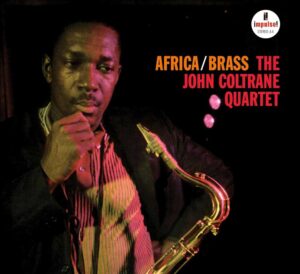
“Africa/Brass”, recorded in May and June 1961 and released in September of that year, was a landmark album for John Coltrane in multiple senses. It was his first release for the Impulse! label, where he’d stay for the rest of his life. It also featured 3/4 of his classic quartet with pianist McCoy Tyner, bassist Reggie Workman, and drummer Elvin Jones, though they were surrounded by as many as 17 other musicians. And finally, it was his only large ensemble recording, unique in his catalogue.
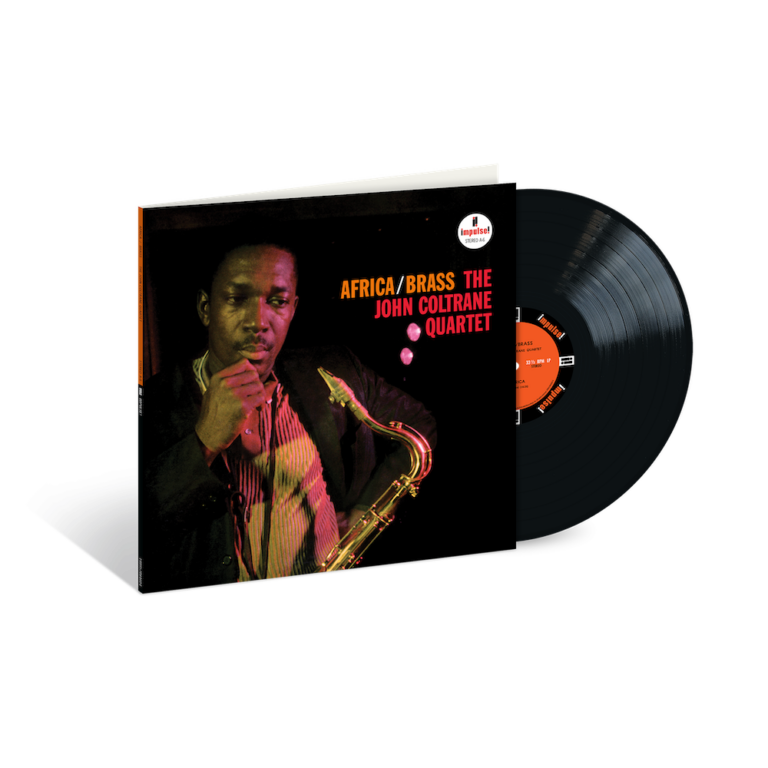
John Coltrane Africa/Brass (Verve Acoustic Sounds Series) 1LP
At the time, Coltrane was working together closely with multi-instrumentalist (alto saxophone, bass clarinet, and flute) Eric Dolphy, who had begun appearing with the quartet live. Together, they sought to expand the parameters of what was possible. As Coltrane put it in a 1961 interview with journalist Benoit Quersin, “There’s more… that a guy will attempt to play now than he would in — whatever — 1955, you know? And things that guys are doing now that’s — in ’55 they would say, ‘Well, man, I don’t know, it’s a little too daring,’ maybe, you know? But now it doesn’t seem that anything can be too daring for a musician nowadays in jazz.”
He was also seeking to expand his melodic and rhythmic capabilities. For years Coltrane had been a master of harmony, finding ways to go all the way up and down the saxophone’s range no matter what chords a piece might call for. This approach peaked on his classic album “Giant Steps”, and continued on “My Favorite Things”. But the music on “Africa/Brass”, which was built on seemingly simple vamps and low-end explorations, encouraged other aspects of his creativity.
As he explained to Quersin, “I’m trying to learn, i’m trying to broaden myself melodically and rhythmically, too, you know? These things that are coming along now are the culmination of — whatever — the things that I’m thinking of in these aspects, rhythmic or melodic. I haven’t forgotten about harmony altogether, but I’m not as interested in it as I was two years ago.”
“Africa/Brass” contains only three tracks, beginning with the side-long “Africa.” For that piece, the quartet are joined by Dolphy, trumpeter Booker Little, trombonist Britt Woodman, euphonium player Carl Bowman, four French horn players (Julius Watkins, Bob “Brother Ah” Northern, Robert Swissheim and Donald Corrado), tuba player Bill Barber, and baritone saxophonist Pat Patrick (of the Sun Ra Arkestra), plus second bassist Art Davis.
The two basses set up a throbbing, almost ominous pulse, weaving around each other for the duration of the tune. As Coltrane described it to journalist Dom Cerulli for the liner notes, “I wanted the band to have a drone. We used two basses. The main line carries all the way through the tune. One bass plays almost all the way through. The other has rhythmic lines around it. Reggie and Art have worked together, and they know how to give and take.” Their interactions, and Jones’ driving beat, are the foundation for a hooting, howling jungle of horns to first play a heavy riff-like melody, then moan and cry as Coltrane steps forward for a passionate aria of a solo.
Coltrane gave Dolphy a great deal of credit for arranging “Africa/Brass”, but he was more circumspect about his contributions, saying, “Actually, all I did was orchestrate. Basically John and McCoy worked out the whole thing. And it all came from John; he knew exactly what he wanted. And that was, essentially, the feeling of his group.”
He continued, ““John thought of this sound. He wanted brass, he wanted baritone horns, he wanted that mellow sound and power.”
The album’s second side begins with “Greensleeves,” an English folk song dating back to the 1500s which was arranged by pianist Tyner and featured in the quartet’s live shows of the time. It has something of the same keening, vamping quality of Coltrane’s version of “My Favorite Things,” a big hit from the previous year and the tune that most defined him in the public mind. As on that track, Coltrane plays long and exploratory soprano saxophone lines, as the large ensemble surges behind him, with Tyner’s heavy piano chords anchoring the music and pushing it forward and Jones chopping up the rhythm in back.
“For me, ‘Greensleeves’ is most enjoyable to play,” Coltrane said. “Most of the time we get a nice pulse and groove. It was a challenge to add the [other musicians] to it. I wanted to keep the feeling of the quartet. That’s why we took the same voicings and the same rhythm McCoy comps in.”
John Coltrane Africa/Brass (Verve Acoustic Sounds Series) 1LP
The album’s final track, “Blues Minor,” is what its title implies, a hard-swinging blues romp that feels like a direct riposte to the ominous “Africa” and proof that Coltrane was still the Coltrane fans had embraced. As he told Cerulli, “There has been an influence of African rhythms in American jazz. It seems there are some things jazz can borrow harmonically, but I’ve been knocking myself out seeking something rhythmic. But nothing swings like 4/4.”
READ ON…
John Coltrane – Architect of Modal Jazz
The Tiberi Tapes – A New Addition to John Coltrane’s Discography for 2026
Phil Freeman is a regular contributor to DownBeat, Stereogum, and The Wire, and a co-founder of Burning Ambulance. He lives in Montana.