

History happens where and when it wants—on a Tuesday evening, or an early Sunday morning—and rarely is it recorded. But sometimes, if we are lucky, it does happen—some witness with some sort of device catches the moment as it unfolds. In the days preceding cellphones and YouTube, it took someone who was determined and willing to invest in the equipment to not let it slip away. Frank Tiberi was that someone who could tell history was being made. Among a select circle of jazz musicians and fans in-the-know, he recorded what he heard and his reel-to-reel tapes of John Coltrane performing in night clubs in the early 1960s were a well-known, much-discussed secret. To the very, very few who were able to hear them, these tapes revealed a rare peek into the mind of the creative comet that was Coltrane in his prime.
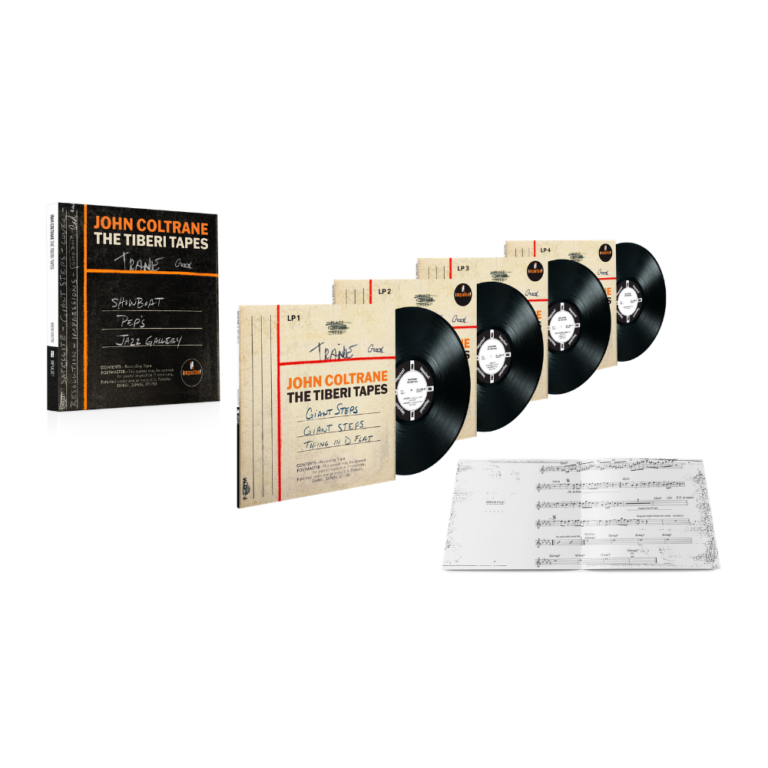
As time progressed, Tiberi’s tapes accrued a legendary aura, whispered about more than heard. Until now that is. In 2026, the year marking John Coltrane’s 100th anniversary, these historic recordings will finally be made available.
Who is Frank Tiberi? Now 97, he is a saxophonist, arranger and teacher who grew up in Camden, New Jersey, and began performing publicly at the age of 15. In the late 1940s and early 1950s, his skills as a sideman were called on by the likes of Benny Goodman, Urbie Green and Dizzy Gillespie. By the late 1950s, as he began to raise a family, he stayed local, gigging regularly in and around the Philadelphia area, playing social functions and in theater orchestras, recording jingles and taking on other studio gigs. As a fan, his passion was the post-bebop of the time, and he frequented clubs that were part of the city’s thriving scene, favoring venues like Pep’s Musical Bar and the Showboat in the city’s primarily Black, southern neighborhood, and catching local stars like Jimmy Heath, Benny Golson and John Coltrane.
Tiberi had come to know Coltrane through his recordings—Cattin’ with Coltrane and Quinichette on Prestige was an early favorite—and from catching him live as a member of Miles Davis’s late 1950s quintet. In 1960, as Coltrane began to establish and lead his own band, Tiberi was entranced by a new approach the saxophonist was developing at a rapid clip. “What he was doing just amazed me,” Tiberi says. “He was an impressionist. He was able to really play and include both his technical ability, his programming and also the feeling that he acquired while he was playing. I just knew this was going to be the future.”
What Tiberi’s ears latched on to was Coltrane’s penchant for superimposing alternative harmonies that allowed for an expanded, emotional vocabulary and extended solos. “He added more area for one to improvise and a lot of color,” he explains. “It gives the musician a lot more advantage being able to perform like that.” Among musicians, these are often referred to as “Coltrane Changes”; Tiberi’s term of choice for Coltrane’s innovation: “deceptive resolutions.”
It was far from just staying on one tonality and playing eight bars. He was able to really revamp a standard like “Body and Soul,” “I Can’t Get Started,” in a more contemporary form. This was all great inspiration to me because you were able to do more voice-leading and stretch out greatly because of the cadences, the deceptive resolutions. You can play one tonality and go to another, which may not be prescribed by the tune, and come back to the tonality that is prescribed and it gives you more opportunity to play openly and be more colorful.
Coltrane’s 1960 album Giant Steps, with groundbreaking tunes like the title track and especially “Countdown,” consolidated the innovations Tiberi marveled at. Some got it, many at the time did not. “During those years, I think Coltrane probably accumulated more interest from musicians,” Tiberi recalls.
He was listening as a horn player would, intent on expanding his saxophone knowledge and skills. In doing so, Tiberi also picked up that there was something different about Coltrane’s playing in live, informal situations, something that he preferred. “It was just the most relaxed situation, compared to all of those albums that he’s done and that I had,” he says.
I had all of them. To me they were not anywhere near the kind of playing and inspiration that he would display at a club. It was just a relaxed situation—I’m talking about the Showboat and, at this particular time, Pep’s, these small clubs, even the clubs I got to up in New York. You know: funky bars, dollar beers. I finally bought this machine.
Tiberi invested in a Magnavox TR-100, a reel-to-reel tape recorder that included a microphone, used 3-inch reels and recorded at 3-3/4 ips to increase recording time. It was heavy and clunky even though it was advertised as a portable unit. He began lugging it to Coltrane’s gigs, and began taping the performances, focusing on the saxophone solos. Sitting with the recorder on his lap in a cloth bag and running the microphone through his coat he learned to replace the reels “like a blind man,” threading the tape with precision in order to catch the next tune, hoping that there would be enough on each reel to catch a full number.
The kind of playing he was doing I couldn’t really grab it all. I’d have to switch the tape and then it would be a gap and he’d still continue on the other side [of the tape]. There wasn’t enough room a lot of times when he would play tunes for 30 or 35 minutes.
When Tiberi got home with the tapes, school was in session. It excited me to be able to transcribe what he was doing. I mean, there was always excitement, and even now, every time I hear these performances, there’s always something to extract from it—to enjoy, to play, to work on, to program.
Tiberi eventually counted more than 80 reels in his archive, containing 60-plus hours of music performed during dozens of Coltrane club performances in a variety of Philadelphia and New York City venues. He had no intent of ever sharing or releasing the recordings. His notations on the tape boxes were sketchy. Some had dates, some did not. The venue was not always notated. Only a few listed all the musicians who performed.
Tiberi’s focus was not on sonic fidelity either and there’s a wide range of listenability among the reels as a result. To maximize the amount of music he could put on the reels, he recorded on one track in one direction, then flipped the
reel and did the same on the other half of the tape. His priority was simply preserving as much of Coltrane’s saxophone playing as he could with the modest equipment he could afford. The tapes were for him to study and absorb, alone. For many years, their existence remained almost totally unknown, save for a few of his students.
“My main purpose of recording him was to really, to get information and harmonic values, so that I could be able to
really play myself, which I’ve done,” Tiberi adds. “And then teaching it to a lot of kids.”
In the 1980s, Tiberi’s career eventually led him taking on a faculty position at Boston’s Berklee College of Music teaching improvisational techniques and also taking over the lead role in Woody Herman’s big band after the clarinetist’s death in 1987. Tiberi had joined Herman’s Young Thundering Herd back in 1969, immediately helping it grow into one of the leading, modernized big bands of the 1970s. In two consecutive years, 1973 and 1974, Tiberi collaborated with trumpeter-arranger Bill Stapleton to create charts that helped the Herd win “Best Jazz Performance—Large Group” Grammy awards for their albums Giant Steps and Thundering Herd. Both featured Coltrane material and ideas born from the discoveries Tiberi drew from the recordings he diligently made.
“Of course, my greatest moment was writing the ‘Countdown’ [chart] for Woody and Friends, recorded at the Monterey Jazz Festival in 1979,” Tiberi notes. He bottom-lines his debt to Coltrane’s influence. “I don’t think I would be teaching. I wouldn’t be the same, I’d be a traditional player. I mean I went through the stages: Lester Young, Charlie Parker, Al Cohn. But after Trane, I got into a contemporary situation.”
Whether intimidation or shyness prevented him, Tiberi never met Coltrane. He never hung out, never came out to the bar. He never announced his tunes either. I saw him one time when he was leaving the club, and he was putting his instruments in the trunk. I was talking to McCoy because we knew each other. I did hear him practicing backstage, but I was a kid then. I didn’t go back there. He was working on some figures in different keys. I have some of that on a tape too.
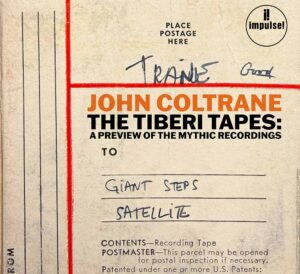
The two tracks on this special Record Store Day disc represent the first time any of Tiberi’s recordings have been
released commercially and benefitted from cutting-edge audio mastering technology. They serve as a preview of
much more to come later this Coltrane centennial year—all of which has been done with the full approval and
participation of the Coltrane Estate.
—Ashley Kahn
January 2026
Ashley Kahn is a Grammy-winning American music historian, author, professor and producer. He teaches at New York University’s Clive Davis Institute for Recorded Music, co-wrote Carlos Santana’s award-winning autobiography The Universal Tone: Bringing My Story to Light (Little, Brown, 2014), and is a producer of Carlos (2023), the documentary on Carlos Santana (Imagine Documentaries/Sony Pictures Classics.