


Within the entire Blue Note catalogue from the 50s to 70s, only two albums were led by singers, both issued in 1962: one by Sheila Jordan, wife of Blue Note pianist Duke Jordan and one by New York jazz singer Dodo Greene.
In the April of 1962, Dodo Greene, from Buffalo, New York, had become the first vocalist to sign an album contract for Blue Note. Recorded at Van Gelder Studio “My Hour of Need” featured tenor saxophonist Ike Quebec, guitarist Grant Green, bassists Herbie Lewis and Milt Hinton, drummers Billy Higgins and Al Harewood and organist Sir Charles Thompson.
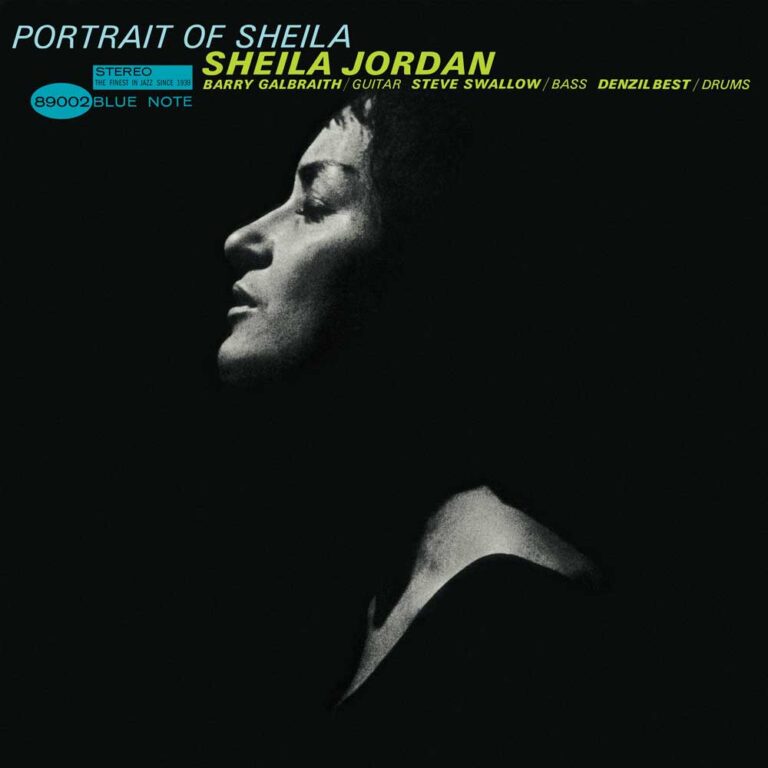
SHEILA JORDAN Portrait of Sheila
Available to purchase from our US store.Working as head of A&R at the label at the time, Ike Quebec convinced Alfred Lion and Francis Wolff to continue the 9000 series despite their initial reluctance after poor sales of “My Hour of Need”.
The singer the label chose for what turned out to be 9002 in this short-lived experiment with vocalists, was Sheila Jordan whose album “Portrait of Sheila” was recorded at Van Gelder Studio on September 19 and October 12, 1962 and released the following year.
While she only recorded the one album for Blue Note she became revered in the world of jazz. A fearless improviser and risk taker she continued recording and performing prolifically through her long career, with her final album, “Portrait Now”, released shortly before her passing in 2025 at the age of 96.
Raised in poverty with her grandparents in Pennsylvania’s coal-mining country, Jordan moved back to Detroit, where she was born in 1928, to live with her alcoholic mother. It was there she heard a Charlie Parker record on a jukebox. “I put my nickel in and Bird came on and it was 4 or 5 notes in and Oh my god! My skin was crawling. I said ‘that’s the music I’ll dedicate my life to’,” she told 20 Questions blog in 2020. It was through Bird that she met Duke Jordan who, like his future wife (they were married between 1952-62) recorded just one album for Blue Note.
After moving from Detroit to New York, Sheila Jordan studied music theory with Lennie Tristano and Charles Mingus before landing a regular gig at Page Three in Greenwich Village with pianist Herbie Nichols. It was there she was spotted by composer-pianist George Russell who featured her on his album “The Outer View”, recorded in 1962 bringing her to the attention of Blue Note for this fascinating album.
A classic Reid Miles cover and beautiful photograph of Jordan by Ziggy Willmann welcomes you into a most unusual album for Blue Note at this time. Accompanied by a trio with Barry Galbraith on guitar, Steve Swallow on bass, and Denzil Best on drums, with no horns or piano, Sheila Jordan brought her own distinctive slant to a collection of eclectic standards.
Modelling her singing on instrumental jazz she had a voice in her early days that James Gavin of the Jazz Times described as “high, fluttery and featherweight, yet trimmed with a bluesy wail”. Combined with a mastery of Bebop vocabulary it was all on display on “Portrait of Sheila”, whether on ballads like “Willow Weep for Me”, the sassy groove of her take on Bobby Timmons’ “Dat Dere” or Rodgers-Hart’s “Falling in Love with Love”.
Of her departure from Blue Note she told 20 Questions: “I like more live recordings where they can record me while I’m performing. I’m not great in the studio. I don’t feel great in a studio in a little booth like that, I never have. I hear every sound, every click.”
As with Dodo Green’s “My Hour of Need”, Sheila Jordan’s Blue Note album was a commercial flop leading to Alfred Lion and Francis Wolff to ditch this rather incongruous series after just two releases. But “Portrait of Sheila” had pointed the way for the music to come from one of jazz music’s most distinctive vocal improvisers.
After her short tenure with Blue Note, Jordan withdrew from music for a time to raise her daughter. When she returned it was into more experimental waters, tackling avant garde and free jazz with the same individuality and spontaneity she brought to bop and ballads.
While she didn’t record another album under her own name until 1975 with “Confirmation” – for the Japanese East Wind label – her long list of recordings as both a featured vocalist and leader included those with Carla Bley, Roswell Rudd and her most regular collaborator Steve Kuhn.
On over 30 albums for labels like SteepleChase, Muse, and HighNote this fiercely unique singer continued to challenge herself and improvise until she passed away listening to the sounds of Bebop that had first inspired her as a Blue Note artist.
SHEILA JORDAN Portrait of Sheila
Available to purchase from our US store.READ ON…
Jutta Hipp: How to Disappear Completely

Blue Note: Tone Poet Releases 2026
Andy Thomas is a London based writer who has contributed regularly to Straight No Chaser, Wax Poetics, We Jazz, Red Bull Music Academy, and Bandcamp Daily. He has also written liner notes for Strut, Soul Jazz and Brownswood Recordings.