
Riding high off the ambitious success of “Africa/Brass”, his first album for the newly founded Impulse Records label, John Coltrane had that record’s reedsman, arranger and close friend Eric Dolphy join his quartet for a string of summer dates on the west coast. But the reviews couldn’t have been more scathing. Most famously the Nov. 23, 1961 issue of DownBeat had associate editor John Tynan accusing Coltrane and Dolphy of being “a horrifying demonstration of what appears to be a growing anti-jazz trend…Coltrane and Dolphy seem intent on deliberately destroying [swing].” Coltrane would spend years trying to shake the “anti-jazz” tag.
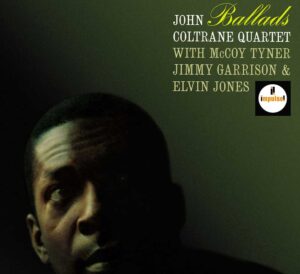
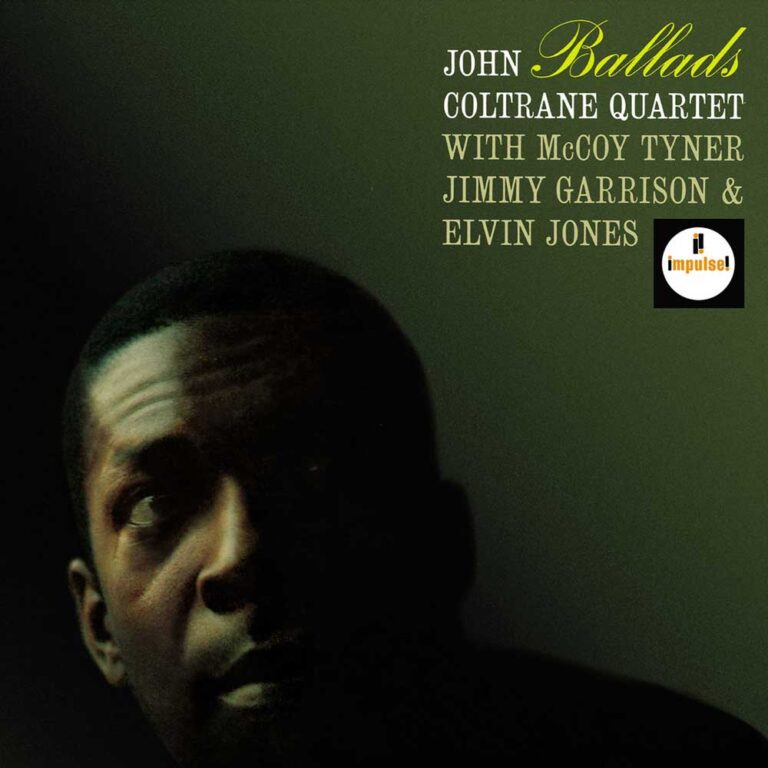
Less than a month after that review ran, Coltrane convened his quartet at Rudy Van Gelder Studio in Englewood Cliffs, New Jersey, laying to tape the Rodgers-Hart ballad, “It’s Easy To Remember.” Originally written for Bing Crosby in 1935 –then made into hits two decades later by the likes of Frank Sinatra, Dean Martin, and Billie Holiday– Coltrane made his horn purr on the standard, wordlessly capturing that bittersweet feeling of love, loss, and regret. It would be released as a b-side for the “Greensleeves” single. But it also became the cornerstone for one of Coltrane’s most beloved, if overlooked albums, “Ballads”.
JOHN COLTRANE Ballads
Available to purchase from our US store.Whether or not it was conceived as a course correction or gentle rebuffing of that notion that he was “anti-jazz,” Coltrane spent the next two years in the studio providing ample evidence that he was very much in the jazz tradition. He recorded with the master Duke Ellington for the generational uniter “Duke Ellington & John Coltrane”, which dismissed the notion that anyone could record with Duke and be “anti-jazz.” Then there was Coltrane’s warming vibrato alongside soothing crooner Johnny Hartman on “John Coltrane And Johnny Hartman”, the vocal jazz album equivalent of a tumbler of perfectly aged whisky.
Sandwiched between them –and the pinnacle of this unofficial trad trilogy– “Ballads” is also one of the sweetest jazz albums culled from the American songbook. As an A.B. Spellman NPR feature on the album once proclaimed, “It’s got some of the most sensitive, heartfelt music that any lover ever sang on a horn…This is ‘falling in love’ music.” But it’s also something of an anomaly in Coltrane’s Impulse catalog. “Ballads” was the album that took him the longest to realise, revisiting this set of standards over various studio dates and taking nearly a year to finally complete it.
Throughout 1962, whenever they weren’t out on the road, Coltrane and band would revisit that erudite kind of song craft that defined jazz and popular music in previous generations. This set of smouldering songs had been made famous by the likes of Bing Crosby, Nat “King” Cole, and Frank Sinatra twenty years prior –plus a few numbers that even predate World War II– and such deeply familiar and popular standards slowly came together in Van Gelder’s studio across multiple dates.
By this point, the Classic Quartet of McCoy Tyner, Jimmy Garrison, and Elvin Jones were fully established. Other sessions like “Coltrane” and “Impressions” capture that chemistry at its most combustive, but “Ballads” manages the fine trick of capturing Coltrane at his most lyrically concise and emotionally direct. “You Don’t Know What Love Is” is the only tune to exceed five minutes. Coltrane’s phrasing throughout remains an unrushed expression of beauty and pathos. His every breath caressed the listener’s ear, humming these familiar melodic lines anew into her ear.
The influence of Duke can be subtly felt throughout. Prior to their encounter, Coltrane was liable to worry over each and every take, while Duke’s preference was to move on quickly, or swap out a song if it wasn’t working that session. Coltrane would soon emulate that efficiency in the studio for the rest of his life. Tyner must have also been paying close attention that day, emulating such relaxed elegance on highlights like “Too Young to Go Steady” and adding a bright and peppy step on “All Or Nothing At All.” Some proponents point to Tyner as the lowkey star of “Ballads”.
JOHN COLTRANE Ballads
Available to purchase from our US store.Through 1963, the Quartet might still pull out Cole Porter’s “Everytime We Say Goodbye” or Billy Eckstine’s “I Want to Talk About You” on the bandstand, but “Ballads” would mark the last time Coltrane would explicitly play in this classical jazz style. With each subsequent Impulse release, he ventured further and further out, until there was no looking back. But for one relaxed album, Coltrane the flamethrower took a step back and crafted an album as warm and romantic as a lit fireplace.
READ ON…
John Coltrane’s Criminally Underrated Record
Sitting in with John Coltrane
Andy Beta is the author of the forthcoming book, “Cosmic Music: The Life, Art, and Transcendence of Alice Coltrane”. He is based in New York City.