
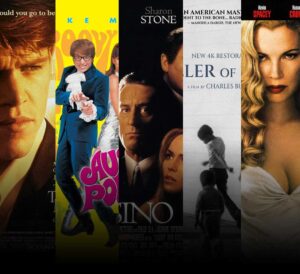
Across the history of cinema there have been many great uses of jazz in soundtracks. Some of the most famous examples include Herbie Hancock’s Oscar-winning work on Bertrand Tavernier’s Round Midnight (1986), Miles Davis’s fully improvised score for Louis Malle’s Ascenseur pour l’échafaud (1958) and Duke Ellington’s score for Otto Preminger’s Anatomy of a Murder (1959). There have been many jazz-tinged scores by master film composers, such as Bernard Herrmann (Taxi Driver), John Williams (Catch Me If You Can), Elmer Bernstein (Sweet Smell of Success, The Man With The Golden Arm), Jerry Goldsmith (the smoky main theme for Chinatown) and Henry Mancini (Touch of Evil, The Pink Panther).
There have been films where the improvisatory nature of jazz has interacted with the improvisatory nature of the filmmaking, such as John Cassavetes’ Shadows (1958) with music by Charles Mingus; films where jazz has been a route into the psyche of characters, such as Gene Hackman’s saxophone-playing surveillance expert in Francis Ford Coppola’s masterful The Conversation (1974); jazz comedies (Some Like It Hot); films about jazz musicians (Bird, Round Midnight, Mo’ Better Blues) and films where jazz has been used to help set the period or location (The Great Gatsby, The Brutalist ).
With so many examples, here is a selection of some particularly special moments…
The Talented Mr. Ripley (“My Funny Valentine” from Chet Baker Sings) –
(and LA Confidential (“Look for the Silver Lining” from Chet Baker Sings))
For lovers of high-quality thrillers, it’s easy to look back nostalgically on the 1990s as a golden period when Hollywood was putting big budgets into lavish, intelligently made thrillers filled with A-list actors. For anyone who sits happily in the intersection of the Venn Diagram combining a love of thrillers and jazz then these two films are the real deal.
Both films are period pieces set in the 1950s, both use jazz from this period to atmospherically set the scene and, more specifically, both feature tracks from one of the great jazz vocal albums – “Chet Baker Sings”.
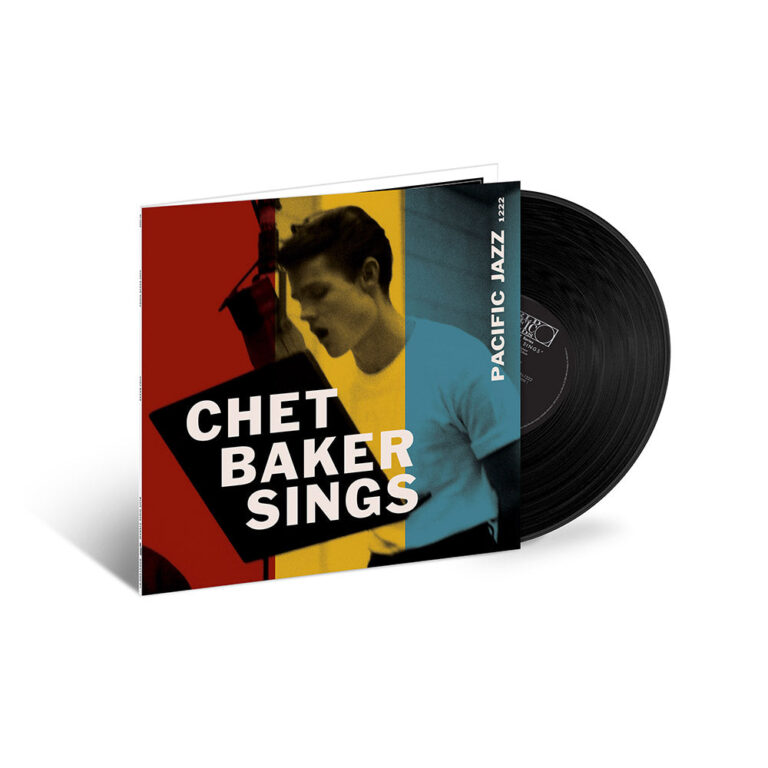
Jazz is threaded right through The Talented Mr Ripley, and is central to the film as a plot device, as classical music loving conman Tom Ripley (Matt Damon) convincingly passes himself as a jazz afficionado to work his way into the life of stylish jazz lover Dickie Greenleaf (Jude Law). The film makes extensive use of jazz in the soundtrack and features live jazz performances on screen (showcasing a number of British jazz musicians – most prominently trumpeter Guy Barker). “My Funny Valentine” first appears on the soundtrack in the form of the Chet Baker version early in the film when Matt Damon’s character is first immersing himself in the music. It becomes a way for Ripley to work his way into the life of Dickie Greenleaf, and the song later appears in the soundtrack sung by Damon himself.
While it’s licensed tracks that provide the strongest jazz elements in both films, it’s worth noting that both films also have stunningly good scores – by Jerry Goldsmith and Gabriel Yared respectively – both Oscar nominated.
These weren’t the only two great 90s Hollywood thrillers with a jazz connection. Another great thriller of that era – The Fugitive, starring Harrison Ford – features the great Wayne Shorter on the score composed by James Newton Howard for the film.
Casino (“The In-Crowd” by Ramsey Lewis)
Martin Scorsese’s brutal portrayal of mob control of a Las Vegas gambling empire ranks alongside Taxi Driver, Raging Bull and Goodfellas as one of his great films. Scorsese often uses licensed music in his films to help set period, locations and add energy. Ramsey Lewis’s hit track “The In-Crowd” brings a great energy to an early scene in the film introducing us to the bustling casino setting.
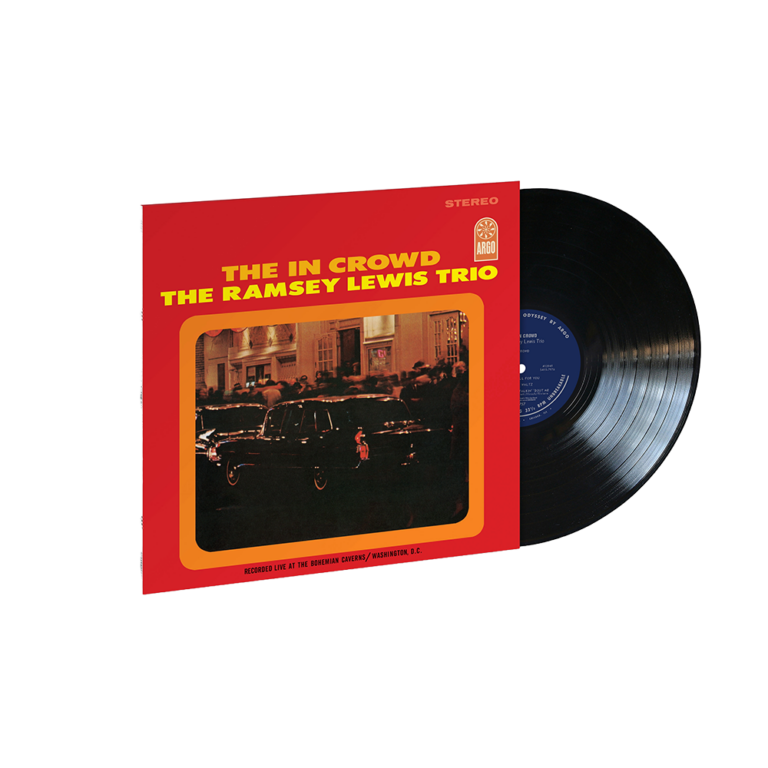
Ramsey Lewis The In Crowd LP (Verve By Request Series)
Later in the film, Jimmy Smith’s “A Walk on The Wild Side” is used in a similar way.
Austin Powers: International Man of Mystery (“Soul Bossa Nova” by Quincy Jones)
Nobody else brought a jazz sensibility to cinema quite like Quincy Jones. Of all the jazz musicians who turned their hand to film scoring, Jones was the master. Jones was prolific in his work for film, and while his skills transcended genre there are many Jones scores where jazz plays a strong role, starting with his first full feature film score, The Pawnbroker, in 1964.
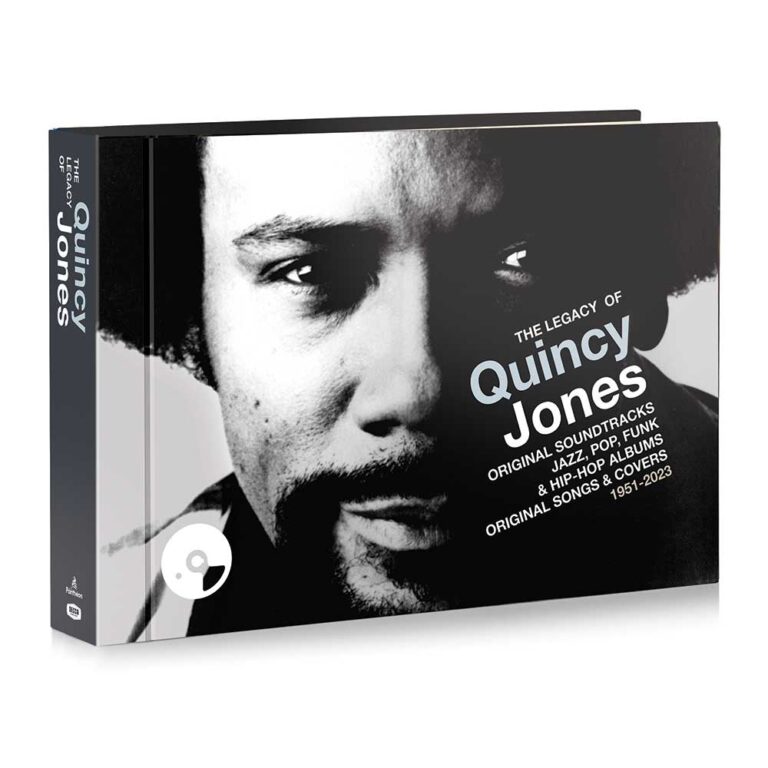
QUINCY JONES The Legacy of Quincy Jones (20CD Boxset)
Available to purchase from our US store.For those wishing to explore Jones’s music in detail in this respect, the recent extensive box set of his work “The Legacy of Quincy Jones” is an embarrassment of riches. With such prolific mastery it is difficult to choose just one example from Jones’s work, so to help balance out some of the darker, more serious selections here, here is something much lighter and just plain fun – the iconic use of Jones’s classic “Soul Bossa Nova” that absolutely sets the tone of Mike Myers’s 1960s-set James Bond spoof Austin Powers – International Man of Mystery.
I can’t quite leave Quincy Jones though without also mentioning one of the all-time great uses of a specially-composed song in a film opening – “On Days Like These” in The Italian Job. The dulcet tones of British crooner Matt Monro soaring with Jones’s sublime melodic writing over his luscious harmonies and hugely inventive orchestration (harpsichord, vibraphone, acoustic guitar, picked electric bass, alto flutes, muted trumpet – yes please!), draws the audience most perfectly into the film.
Killer of Sheep (“This Bitter Earth” by Dinah Washington)
An under seen piece of 1970s independent cinema, Killer of Sheep (1977) did not receive a proper release at the time it was made, and despite winning the Critics’ Award at the 1981 Berlin Film Festival, and first prize at the 1982 Utah/U.S. Film Festival (the precursor to Sundance), the film languished in obscurity for decades.
Shot on grainy black-and-white 16mm film, on a limited budget and mostly on weekends between 1972 and 1973 – as director Charles Burnett’s thesis film at UCLA – Killer of Sheep is a neo-realistic, poetic portrayal of working-class Black American life in 1970s Los Angeles. It is a beautifully made, intimate portrait of humanity, bringing a European cinematic sensibility to Black American urban life in the Watts neighbourhood of LA, which had suffered intense police brutality and racial discrimination in the late 1960s.
Burnett finds poetry and beauty in his portrait of this community. Dinah Washington’s “This Bitter Earth” is beautifully used in a poignant scene when Stan – the film’s titular abattoir worker – attempts to slow dance with his wife, in this intimate moment beautifully framed in a single shot as the music plays. It’s one of the most lyrical moments in the film.
Washington’s vocal on the track achieved greater cinematic prominence decades later when it was combined with composer (and current Oscar-nominee) Max Richter’s perennial composition “On The Nature of Daylight” in a key scene in Martin Scorcese’s Shutter Island (2010).
Bad Timing (“Part I” from Keith Jarrett – Köln Concert)
The music of the ECM label often has a spaciousness, emotiveness and cinematic quality that makes it particularly suitable for use in film. There are a number of examples of highly effective use of ECM tracks in drama, with some notable ones including Michael Mann’s classic Hollywood crime thriller Heat (1995), which makes atmospheric use of music by ECM artists David Darling and Terje Rypdal; William Friedkin’s gritty crime drama Cruising (1980), which uses a Barre Phillips track as a leitmotif as well as music by Ralph Towner; and Jean-Luc Godard’s Nouvelle Vague (1990); as well as on the smaller screen the acclaimed drama series Homeland (2011-2020), which made significant use of Tomasz Stanko’s track “Terminal 7”.
One of the most cinematic examples though is the use of music from Keith Jarrett’s iconic solo piano “Köln Concert” album in Nicolas Roeg’s Bad Timing (1980).
Nicolas Roeg ranks among the greatest and most idiosyncratic of British film directors, cementing his place in cinema history with a run of key films in the 1970s: Performance (1970), Walkabout (1971), Don’t Look Now (1973) and The Man Who Fell To Earth (1976).
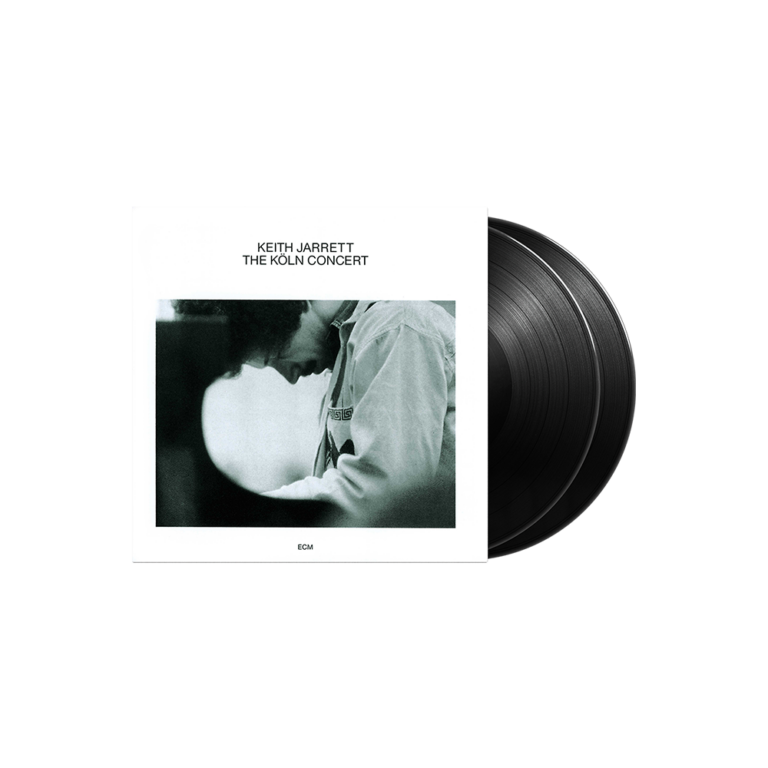
Bad Timing (1980) is probably Roeg’s most divisive and controversial film. The film’s own distributor, the Rank Organisation, famously described it as “a sick film made by sick people for sick people.”, while others have declared it a masterpiece. It remains controversial. Setting moral questions aside though there is no denying Roeg’s visual and cinematic mastery, and the film is perhaps at its most cinematic in the three sequences scored with Jarrett’s solo piano music from “Köln Concert”, the most notable and extended of these coming around an hour and a quarter in, when a full four and a half minutes of “Part 1” from “Köln Concert” underscores an intensely emotional confrontation between lead characters Milena (Theresa Russell) and Alex (Art Garfunkel). Roeg personally met with Jarrett to seek permission to use the music in the film and it elevates the visuals and emotional character of the scene to a different plane.
READ ON…
Alain Goraguer: A Cult Classic Soundtrack

Blue Giant Momentum: An Interview with Shinichi Ishizuka
Jon Opstad is a London-based composer working across film & television, contemporary dance, concert music and album projects. His scores include the Netflix hits Bodies and Black Mirror, and Elisabeth Moss thriller The Veil, co-composed with Max Richter. An avid record collector, he has a particular affinity for the music of ECM.
Header image: