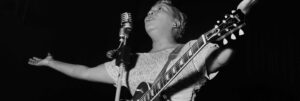
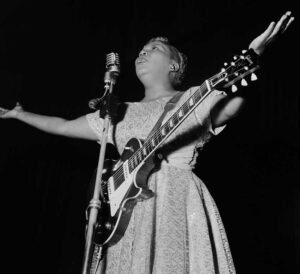
Sister Rosetta Tharpe, gospel music’s first superstar, was a prodigy. A maverick who defied expectations and stereotypes, both inside and outside the church, she straddled the worlds of gospel and popular music, playing an electric guitar that seemed to speak its own language through its distorted sound, and exhibiting an extraordinarily powerful voice that invoked the spirit with every note she sang.
This Verve reissue of her 1956 album, ‘Gospel Train’, captures her at a pivotal point in her career. By then, already established as a major star, she was equally at home in revival tents and concert halls, and had spent nearly two decades breaking down the boundaries between sacred and secular music.
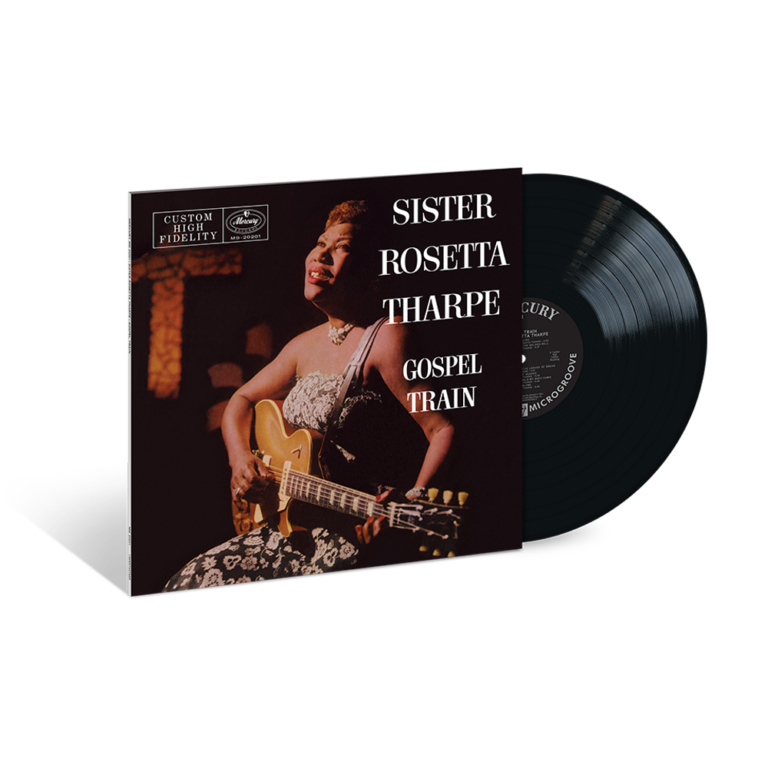
Sister Rosetta Tharpe Gospel Train (Verve Vault Series) 1LP
To understand what makes the music of Sister Rosetta Tharpe so compelling, you have to start with her background in the church.
Born in Cotton Plant, Arkansas, in 1915, Rosetta was raised in the sanctified tradition of the Church of God in Christ, a branch of Pentecostalism that embraced speaking in tongues, ecstatic worship and music that engaged the whole body. Her mother, Katie Bell Nubin, was an itinerant preacher, and Rosetta’s education came not from a conservatoire but from churches and revival meetings.
Apparently, she could pick out gospel tunes on the piano as a toddler, and by the age of six she was being lifted onto a piano so congregations could see the tiny girl singing and playing the guitar.
There is nothing quite like church training for an artist. The congregation may applaud you, but their focus is elsewhere. They want the music to bring them closer to God. It humbles and elevates you in equal measure. The passion heard throughout ‘Gospel Train’ comes directly from that tradition: altar calls, sinners seeking forgiveness, and ordinary people yearning for something greater than themselves.
Anyone who has spent time in a Pentecostal church will recognise that sound immediately. It’s the sound of testimony, longing, relief, and joy breaking through despair. Rosetta wasn’t merely imitating that feeling. She came from it.
‘Gospel Train’ is not a crossover album trying to appeal to a secular audience. The songs are unapologetically Christian, with a little extra sauciness thrown in for good measure. By the time it was released in 1956, Rosetta was no longer torn between gospel and popular music; she had created a musical landscape entirely her own.
While some churchgoers worried she was taking sacred music into unholy spaces, Rosetta never saw a contradiction. As she once put it: “I sing real songs for real people because I believe if you can make them feel it, they’ll see it. I don’t care where I sing it; I just say my little prayer and go on and sing.” Despite appearing on stages such as the famous Harlem Cotton Club and Carnegie Hall, and hanging out with jazz superstars such as Cab Calloway and Duke Ellington, she never abandoned her roots, juggling her sacred calling with her popularity.
And then there is the ‘train’ itself. In gospel music, trains rarely mean just trains. They symbolise salvation, freedom and the journey towards something better. In Rosetta’s hands, the music becomes a vehicle carrying people from sin to redemption and from despair to joy. To get a visual sense of her powerful voice, search online for the wonderful grainy black-and-white footage recorded live for a TV programme by Granada TV in Manchester in 1964. She stands on a platform at a disused railway station, unleashing an elemental vocal force, hollering “Didn’t It Rain” across the tracks to an assembled crowd on the opposite side. Legend has it that future members of the British rock aristocracy were among those watching; whether the rumour is true hardly matters. What is undeniable is that the performance still crackles with electricity decades later.
What strikes me most is how vibrant ‘Gospel Train’ sounds. Unlike many recordings of its era, it takes us to church. Not the polite, hymn-book type, but the messy, hollering, dancing, unrestrained joy of a spirit-filled service. And it asks us to participate. The jaunty rhythms convey such joy that remaining still almost feels like an act of resistance. Even if you don’t share Rosetta’s faith, you can understand the feeling, the sense that, for a few moments at least, the music is carrying life’s burden for you.
Throughout the album, there is movement, momentum and an infectious sense of joy. Her reworking of ‘Precious Memories’ is a perfect example. Traditionally sung as a reflective hymn, Rosetta turns the tune into something rhythmic and propulsive without sacrificing its devotional power. The song swings. It moves. It points directly towards early rock and roll while remaining firmly rooted in gospel.
Rosetta’s voice could shift from tenderness to exhortation in a single phrase. At times she sounds like a preacher, at others a storyteller, sometimes both at once. Alongside her remarkable vocal dexterity, she gave the electric guitar a voice of its own. Listen to her original tune ‘Can’t No Grave Hold My Body Down’: she wrings every possible emotion from the instrument, bending notes, pushing phrases, and making the guitar cry, testify, and shout alongside her voice.
People often talk about the birth of rock and roll as if it appeared from nowhere. Baz Luhrmann debunked this by including Sister Rosetta Tharpe in his film ‘Elvis’. She appears only briefly, yet her presence reminds us that rock and roll did not simply arrive with Elvis Presley. As Rosetta herself observed, “These kids and their rock’n’roll is just sped up rhythm and blues. I’ve been doing that forever.” In many ways, ‘Gospel Train’ is the sound of that claim being borne out. Her singular talent laid the foundations for what followed. Rosetta was not bringing rock and roll into the church; she was taking the church into rock and roll. And if you listen carefully to Little Richard, Chuck Berry or Elvis Presley, her influence is impossible to ignore.
She never sang as though she were remembering belief, but as though she had just discovered it. On the standout track ‘Two Little Fishes, Five Loaves of Bread’, written by Bernard D. Hanighen, who also worked closely with Billie Holiday, Rosetta pushes her voice to the edge of comfort, creating a thrilling tension that never quite resolves. When she reaches the plea that we should “…love one another…”, it lands not as sentimentality but as genuine conviction.
By the time of Sister Rosetta’s death in 1973, she had faded into relative obscurity, and many of the artists she inspired had become better known than she was. But what a legacy she has left us. Listening to ‘Gospel Train’ now, what strikes me most isn’t how influential Rosetta was, but how alive she still sounds. Nearly seventy years later, these recordings still pulse with joy, urgency and conviction. You can hear the church in them, you can hear the birth of rock and roll in them, but above all, you hear an artist utterly convinced of the power of song.
Sister Rosetta Tharpe Gospel Train (Verve Vault Series) 1LP
Header image: Sister Rosetta Tharpe, Sophia Gardens, Cardiff, Wales, 1957. Photo By Chris Ware/Getty Images/Hulton Archive
READ ON…
Ron Carter, Ricky Dillard, Joel Ross – New Gospel Jazz
5 Outstanding Singer-Pianists
Jumoké Fashola is a journalist, broadcaster, and vocalist who currently presents a range of Arts and culture programmes on BBC Radio 3, BBC Radio 4, and BBC London.